
Quick answer: Choosing SEO in-house vs outsourcing comes down to workload and control. An in-house hire knows your catalog day to day, while outsourcing buys a team of skills for less than one salary. For most ecommerce stores without a full-time SEO workload, a hybrid works best: one internal owner plus an outside specialist.
What to Look For Before Choosing SEO In-House vs Outsourcing
SEO in-house vs outsourcing is a choice about who does the work and who owns the results. In-house means an employee on your payroll handles search. Outsourcing means an agency, consultant or freelancer does it under contract. The right pick depends on your workload, your budget and how much store access you can hand over.
Most store owners weighing an SEO agency vs in-house SEO vs an SEO consultant start with price. Start with the work instead. How many catalog changes does your store create each month? Who can edit product templates, collections and redirects on your platform? And who on your side will approve changes?
That last question gets skipped a lot. Even a fully outsourced setup needs one person inside the business with the authority to say yes.
TL;DR
- The closest BLS occupation, market research analysts, had a median pay of $78,760 a year in May 2025, before benefits or tools.
- Ahrefs polled 439 SEO providers and found an average retainer of $2,917 a month, with $501 to $1,000 the most common range.
- Google says SEO changes can take from a few hours to several months to show, so judge any setup over months.
- A hybrid model, an internal owner plus an outside specialist, suits most ecommerce stores.
In-House vs Outsourced SEO: How the Options Compare
In the in-house vs outsourced SEO comparison, in-house wins on product knowledge and speed on small fixes. Outsourced SEO wins on range of skills and cost per skill. A hybrid splits the job: your team owns approvals, and an outside specialist handles audits and strategy.
| Factor | In-house SEO | Outsourced SEO | Hybrid |
|---|---|---|---|
| Cost basis | Salary, benefits and tools | Monthly retainer or project fee | Part-time internal time plus a smaller retainer |
| Knowledge of your products | Deep, day to day | Has to be learned | Internal owner supplies it |
| Range of skills | Limited to one or two people | Technical, content and links in one team | Specialist fills the gaps |
| Speed on small fixes | Fast with platform access | Depends on access and queue | Fast, the internal owner ships fixes |
| Risk if one person leaves | High, knowledge walks out | Lower, work is documented in reports | Medium |
How Much Does In-House SEO Cost Compared With Outsourcing?
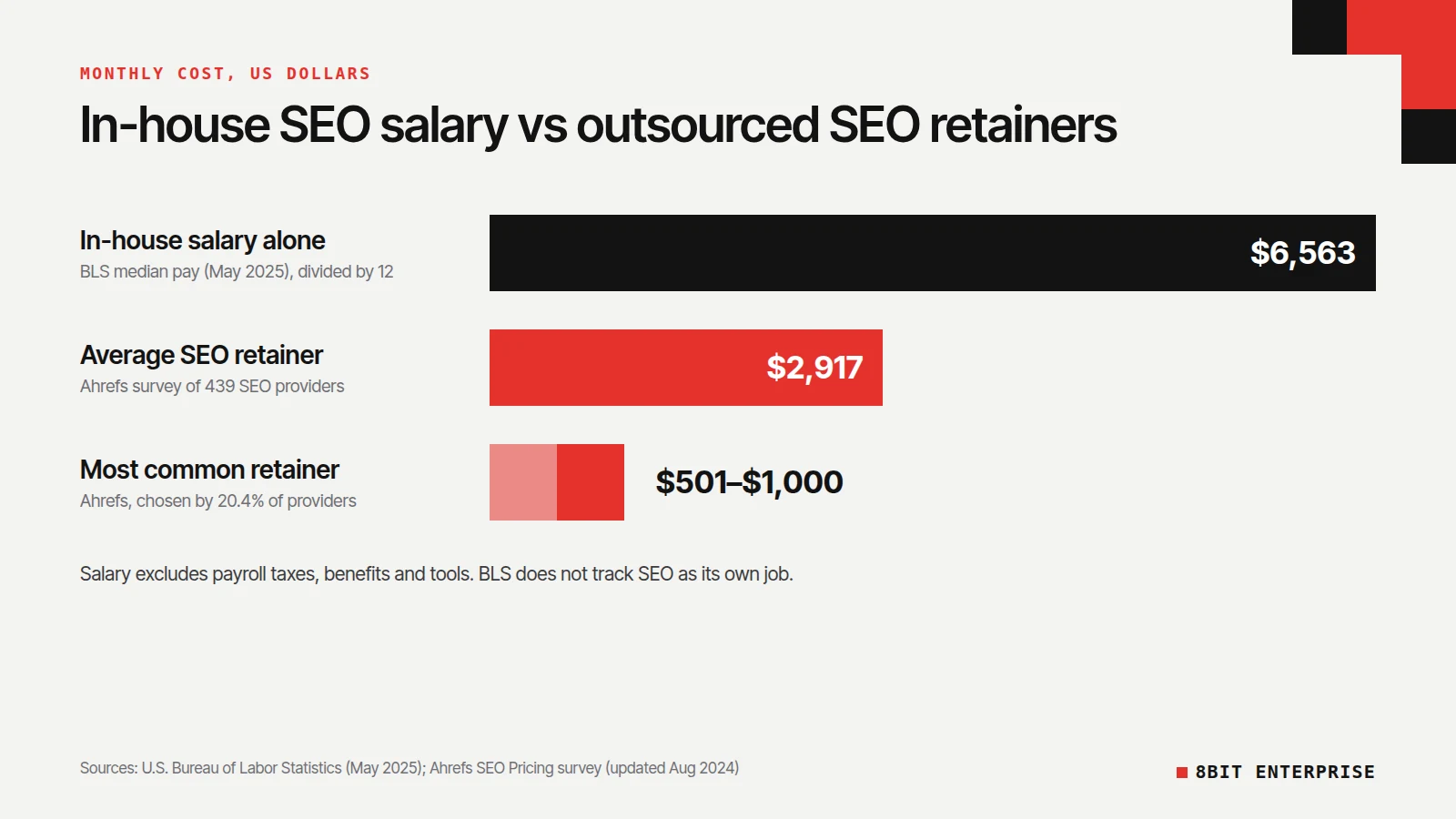
One in-house hire usually costs more than an average agency retainer. The U.S. Bureau of Labor Statistics puts median pay for market research analysts, the closest occupation it tracks, at $78,760 a year as of May 2025. Ahrefs puts the average SEO retainer at $2,917 a month.
Run the numbers. $78,760 divided by 12 is about $6,563 a month in salary alone, before payroll taxes, benefits and tools. The BLS occupational profile for market research analysts doesn’t list SEO as its own job, so treat that figure as a rough floor for a generalist, not a quote for a senior technical SEO.
Outsourced prices vary just as much. In the Ahrefs survey of 439 SEO providers, 20.4% charged $501 to $1,000 a month, the most common range, and the average hourly rate was $111. That page was last updated in August 2024, so get current quotes before you set a budget.
A cheap retainer isn’t automatically good value. Ask what’s in scope. Does the fee include making the changes, or only recommendations your developer must build?
Should You Hire an SEO Company Versus Keeping It In House?
Hire an SEO company when your store needs several skills at once, such as technical fixes, content and link building, and the work can’t fill a full-time role. Keep SEO in house when search is a core sales channel, the workload is steady, and you want someone who knows every product line and promotion. If you decide to hire, our guide to choosing an ecommerce SEO agency has a scorecard for comparing them.
When in-house makes sense
A large catalog creates constant SEO work: new collections, seasonal pages, discontinued products and their redirects. If that work fills a full week, an employee who sits next to your merchandising team will move faster than an outside team working through tickets.
When outsourcing makes sense
Smaller stores rarely have a full-time SEO workload. A retainer gives you a technical specialist, a writer and an analyst for less than one salary. The tradeoff is context: an outside team needs time to learn your products, margins and customers, and it can only move as fast as your access allows. Choosing an SEO agency vs an in-house team for ecommerce often comes down to that access question.
Is SEO Agency vs Doing SEO Yourself a Real Choice for Store Owners?
Doing SEO yourself covers the basics on a small store, because platforms handle part of the technical setup. Shopify says all stores automatically generate a sitemap.xml file. DIY stops working when you need deeper fixes, such as duplicate product URLs, filtered navigation or a platform migration.
Google’s SEO Starter Guide is a solid free place to begin, and it suggests hiring a professional if you’re short on time. Shopify’s sitemap documentation shows what the platform already does for you.
Be honest about your hours. SEO squeezed into spare moments tends to stall, and technical problems are where it stalls first. That’s usually the point where a specialist pays for themselves.
What Should Stay In-House Even When You Outsource SEO?
Approvals, product knowledge and platform access should stay inside your business, even with a full-service agency. Outsourcing moves the work, not the ownership. Someone on your team still has to set priorities, confirm what’s in stock and sign off on changes to templates, prices and redirects before they go live.
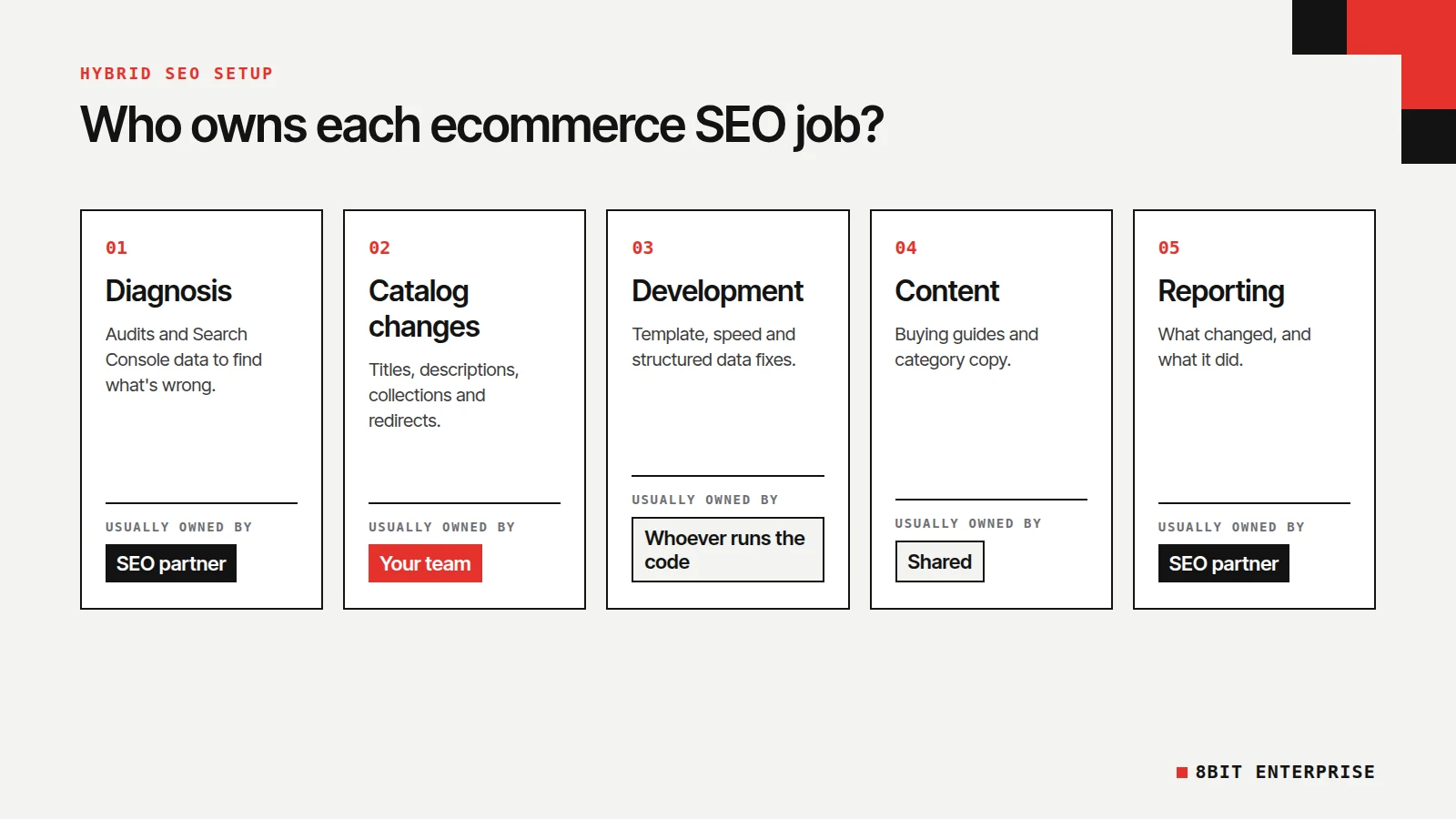
Most comparisons of in-house SEO vs outsourced SEO miss this part. Split ecommerce SEO into five jobs and decide who owns each one:
- Diagnosis: finding what’s wrong through audits and Search Console data.
- Catalog changes: titles, descriptions, collections and redirects for removed products.
- Development: template, speed and structured data fixes.
- Content: buying guides and category copy.
- Reporting: what changed, and what it did.
An agency can own diagnosis and reporting easily. Catalog changes usually need your merchandiser. Development depends on who controls the theme or code. If nobody owns a job, it doesn’t get done, however good the retainer looks.
Red Flags to Watch For When Choosing SEO Help
Google’s own advice is the best filter: walk away from anyone who guarantees rankings. Google states plainly that no one can guarantee a number one ranking on Google. The same page warns against firms that email you out of the blue or won’t clearly explain what they intend to do.
The same test works for in-house candidates. Anyone who can’t show past work, won’t share every change made to your site, or never asks about your customers and competitors is guessing. Google’s guide to deciding whether you need an SEO lists the questions worth asking, including what results to expect and in what timeframe.
Our Top Pick for Most Ecommerce Stores: A Hybrid Model
For most small and mid-size stores, the best answer to SEO in-house vs outsourcing is a hybrid. Keep one internal owner who knows the catalog and can approve changes, then outsource the specialist work. You get expert skills without a senior salary, and you keep control of your store and its data.
Set it up in five steps:
- Name an internal SEO owner, even if it’s a part-time role.
- List the five jobs above and assign each one to a person or a partner.
- Give your partner the access they need, including Search Console and a staging copy of your theme.
- Agree what the monthly report must show: changes made, pages affected and results.
- Review the split after six months and bring work in-house once it fills a full role.
Our ecommerce SEO services page explains what outsourced SEO with us covers, so you can compare it against your own list.
Frequently Asked Questions
Should I hire an in-house SEO specialist or an agency?
Hire an agency if your SEO workload is below a full-time role or you need several skills at once. Hire an in-house specialist when search drives a large share of sales and the work is steady. The BLS median for the closest occupation was $78,760 a year in May 2025, so compare that with agency quotes.
What are the pros and cons of hiring an in-house SEO?
An in-house SEO trades range of skills for depth of product knowledge. The main points:
- Pro: deep knowledge of your products and customers.
- Pro: fast on small fixes when they have platform access.
- Con: one person rarely covers technical, content and link work.
- Con: their knowledge leaves when they do.
What should you look for when hiring in-house SEO talent?
Look for proof of past ecommerce work, comfort with Google Search Console and a habit of explaining every change. Google advises asking any SEO what results they expect and in what timeframe. Skip anyone who promises a number one ranking, since Google says nobody can guarantee one.
How do you build an in-house SEO team?
Start with one SEO owner who can work directly with your developer and merchandiser. Add specialists only when the work is steady, usually a content writer first, then technical help for templates and speed. Outside experts can still cover one-off work like audits and migrations.
How long does SEO take to show results?
Google says changes can take anywhere from a few hours to several months to appear in search results, and it suggests waiting a few weeks before judging a change. Whichever side of SEO in-house vs outsourcing you pick, set review points by quarter, not by week.
Conclusion
SEO in-house vs outsourcing isn’t an all-or-nothing call. Outsource the specialist work while it’s part-time, keep ownership and approvals inside, and hire in-house once search work fills a full role. If you want a second opinion on the right split for your store, book a free discovery call with 8Bit Enterprise.