
Quick answer: GEO for ecommerce means making your online store easy for AI tools like ChatGPT and Google AI Mode to find, trust and recommend. Most of the work is good SEO aimed at the right pages: clean product data in feeds, plus buying guides and trust pages that answer real shopper questions.
What Is GEO for Ecommerce?
GEO for ecommerce is the practice of getting your products and store mentioned inside AI-generated answers. GEO stands for generative engine optimization. For an online store it covers two jobs: giving AI shopping tools accurate product data, and publishing pages worth citing when shoppers ask what to buy and why.
The term came from a 2023 research paper, and vendors have been selling it hard ever since. A lot of that advice is vague or unproven. This guide sticks to what primary sources say, including one that may surprise you: Google doesn’t think GEO is a separate discipline at all.
We’ve based it on Google’s own documentation, the original academic study, OpenAI’s merchant specification and an October 2026 citation study of real online stores. Where the evidence is thin, we say so.
TL;DR
- Google says optimizing for its AI search is still SEO, and that you don’t need special AI files or markup.
- Adobe found AI traffic converted 90% better than non-AI traffic at US retailers in September 2026.
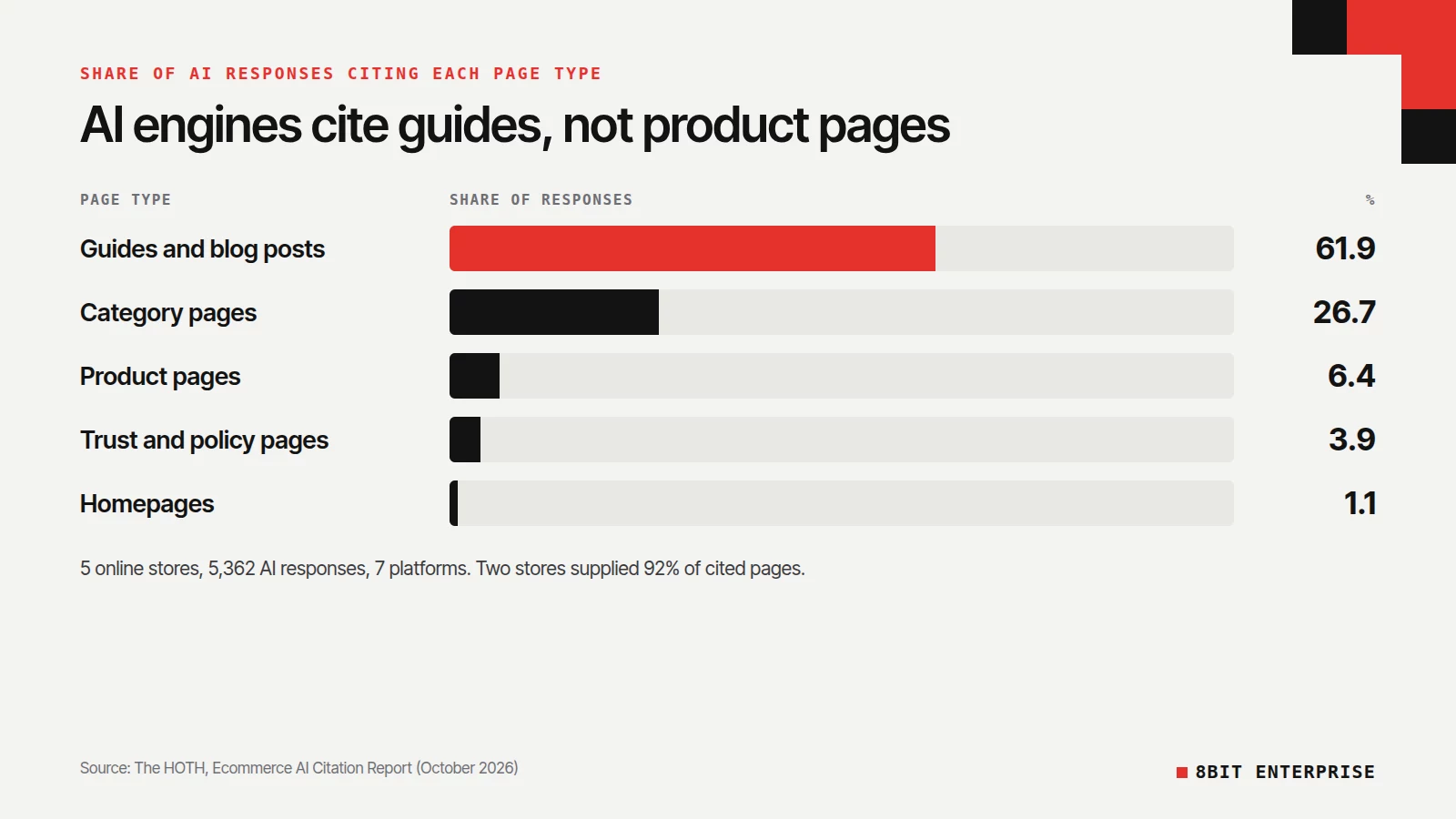
- In a five-store study by The HOTH, guides earned 61.9% of AI citations and product pages just 6.4%.
- Product pages still matter, but mostly through feeds such as Google Merchant Center.
Is Generative Engine Optimization the Same as Traditional SEO?
Generative engine optimization overlaps heavily with traditional SEO, and Google treats them as one thing. Its documentation says that optimizing for generative AI search is optimizing for the search experience, and thus still SEO. A page must be indexed and eligible to show with a snippet before Google’s AI features can use it.
Google’s guide to optimizing for AI features is blunt about the extras. You don’t need new machine-readable files, AI text files or special markup to appear in Google Search. It also says there’s no requirement to break content into tiny pieces for AI.
So why does the GEO vs SEO debate exist at all? Because Google isn’t the only engine. ChatGPT, Perplexity and others choose sources their own way, and shopping assistants increasingly read product feeds directly. GEO is a useful label for that wider job of AI search optimization.
Answer engine optimization vs generative engine optimization
You’ll see both phrases, and in practice they describe nearly the same work. Answer engine optimization usually refers to winning direct answers and featured snippets. Generative engine optimization refers to being cited inside AI-written responses. Don’t pay extra because an agency sells them as two separate services.
Why Does GEO for Ecommerce Matter Right Now?
GEO for ecommerce matters because shoppers who arrive from AI tools are buying more than other visitors. Adobe reported that in September 2026, AI traffic to US retail sites converted 90% better than non-AI traffic and produced 83% higher revenue per visit, the widest gap it had recorded that year.
Those numbers come from Adobe’s retail data for the 2026 holiday season. Adobe also found these visitors spent 73% more time on site and added products to carts at a 53% higher rate.
Keep this in perspective. Adobe measures clicks from AI tools to retail sites, and these figures describe the quality of that traffic, not how much of it there is. Treat AI as an early, high-quality channel alongside organic search and paid ads, not a replacement for them.
Which Store Pages Do AI Engines Actually Cite?
AI engines cite guides far more than product pages. In a study published by The HOTH in October 2026, guides and blog posts were 30.2% of cited pages but earned 61.9% of responses. Product pages made up 25.1% of cited pages and earned just 6.4%. Most GEO advice aimed only at product pages misses this.
The HOTH ecommerce citation report looked at five online stores and 5,362 AI responses across seven platforms, including ChatGPT, Gemini, Perplexity and Google AI Mode.
| Page type | Share of cited pages | Share of AI responses | What to do |
|---|---|---|---|
| Guides and blog posts | 30.2% | 61.9% | Publish buying guides that answer specific questions |
| Category and collection pages | 42.8% | 26.7% | Add useful copy, filters explained and FAQs |
| Product pages | 25.1% | 6.4% | Keep accurate, and put the effort into your feed |
| Trust and policy pages | 1.4% | 3.9% | Strengthen returns, authenticity and shipping pages |
| Homepages | 0.6% | 1.1% | Say clearly what you sell and who you are |
Two caveats. Two of the five stores supplied 92% of the cited pages, and page types were sorted by URL pattern. It’s one vendor study, not settled science. The direction is still useful, and it matches what the authors suggest: product details increasingly reach AI through structured feeds instead of page citations.
Look at trust pages in that table. They’re rare, but each one was cited heavily. One store’s authenticity page alone picked up 74 citations. Shoppers want to know a store is legitimate before they buy, and a clear returns or authenticity page answers that.
How Do You Get an Ecommerce Site Recommended by AI?
To get a store recommended by AI, build three things: accurate product feeds, guides that answer buying questions, and proof that other people trust you. GEO for ecommerce sites works best when all three agree, because AI tools compare what your store says with what the rest of the web says.
Product feeds come first
Google says Merchant Center feeds can help products appear in AI responses and other Search results. If you sell physical products and don’t have a feed, start there.
ChatGPT has its own route. OpenAI’s product feed specification lists nine required fields: item ID, title, description, URL, brand, seller name, image URL, availability and price. It also tells merchants to update prices and availability whenever they change. Even if you never submit a feed to OpenAI, those nine fields are a good test of your product data.
Your platform affects how much of this you do by hand. If you’re still deciding, our Shopify vs WooCommerce comparison covers how much each one handles for you.
Write guides with evidence in them
The original GEO study from Princeton and partners, accepted at KDD 2024, tested which edits make content more visible in AI answers. Adding quotations, statistics and cited sources worked best, with relative gains of 30-40% on its main visibility measure. Keyword stuffing gave little to no improvement.
The biggest gains went to pages that weren’t already on top. Citing sources lifted the fifth-ranked result by 115.1%, and it reduced visibility for the top result by 30.3%. That’s encouraging for smaller stores. Lab results on a benchmark aren’t a promise for your site, though.
For a store, this means a guide that compares sizes, materials or use cases, and backs each claim with a test, a measurement or a named source.
Earn outside proof
Google advises against inauthentic mentions, and fake ones can backfire. Real proof is slower: verified customer reviews, comparisons on independent sites, and honest answers in places your buyers already ask questions.
GEO Implementation Checklist for Ecommerce Websites
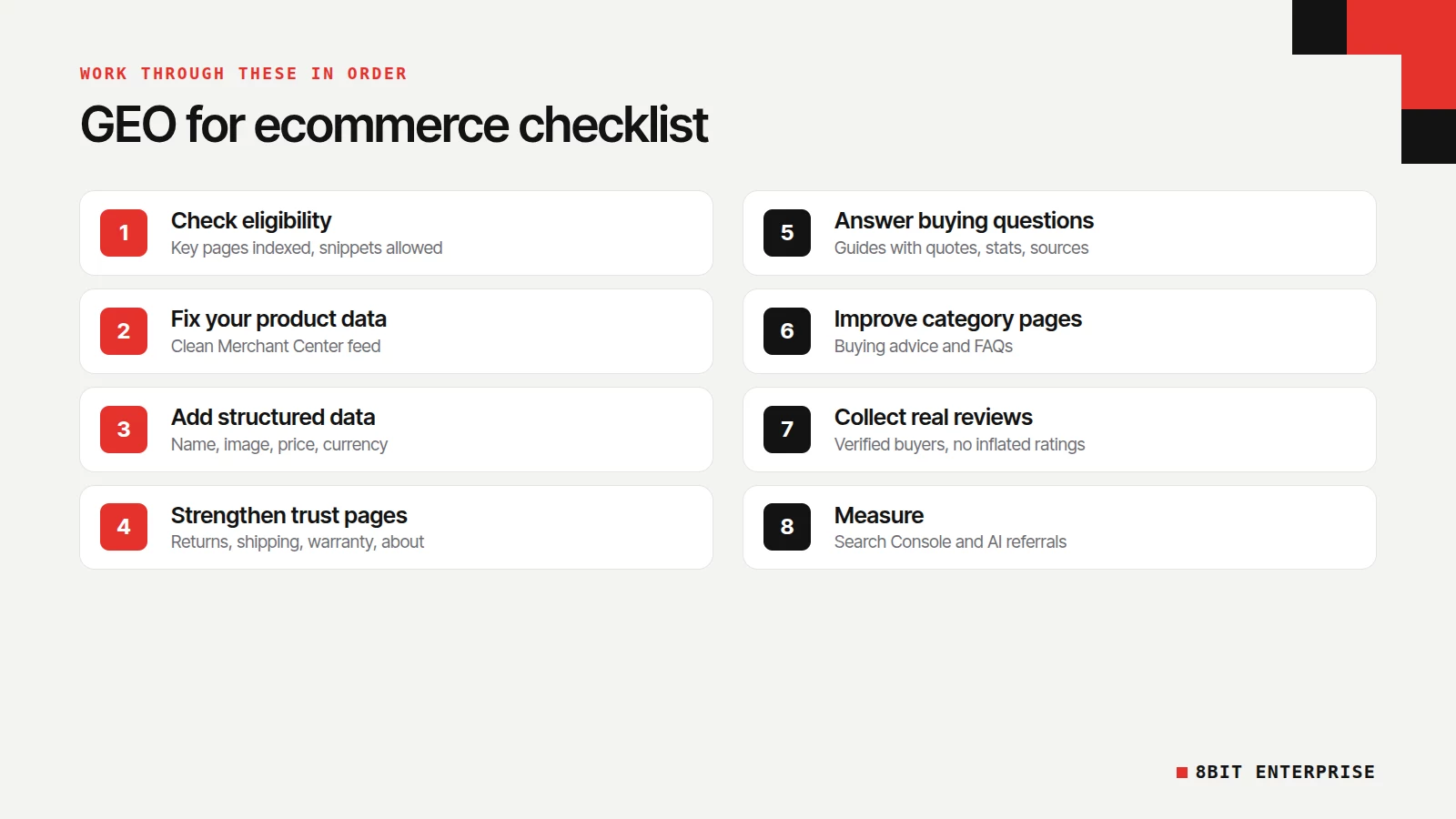
This GEO implementation checklist puts the highest-value work first, and the first four steps need no new software. GEO for ecommerce websites starts with the basics, so work through them in order. Feed and indexing problems will limit everything after them, however good your content is.
- Check eligibility. Confirm key pages are indexed in Google Search Console and can show a snippet.
- Fix your product data. Set up or clean your Google Merchant Center feed, and check it against the nine fields in OpenAI’s specification.
- Add merchant listing structured data. Google’s documentation requires name, image and offer details with price and currency. It won’t unlock AI features by itself, but it keeps your data consistent.
- Strengthen trust pages. Write clear returns, shipping, warranty and about pages with real policies and contact details.
- Answer buying questions. Publish one guide per major category, using quotations, statistics and sources.
- Improve category pages. Add short buying advice and FAQs that a shopper would actually use.
- Collect real reviews. Ask every verified buyer, and never inflate ratings.
- Measure. Use the generative AI performance report in Search Console, and track AI referrals in Google Analytics. Our guide to measuring generative engine optimization walks through both.
Treat this as a technical GEO checklist and a content plan at once. Steps one to three need a developer or a capable store manager. Steps four to seven need someone who knows your products.
Common Mistakes to Avoid With GEO for Ecommerce
The most common mistake is buying tactics Google has already said it ignores. Adding an llms.txt file won’t change your Google Search visibility, and chopping content into tiny chunks isn’t required. Other frequent errors are mass-producing thin pages, stuffing keywords and trusting tools that promise inside knowledge of AI rankings.
Scaled pages are the riskiest. Google says mass-producing pages to target query variations, primarily to manipulate rankings or AI responses, violates its scaled content abuse policy. An AI-written page for every product and city combination could cost you more than it gains.
Be careful with GEO tools too. Google warns about third-party tools claiming access to its internal ranking or AI systems. Citation trackers can show patterns, but they sample a tiny slice of possible prompts.
Don’t ignore your existing rankings, either. A page that isn’t indexed can’t appear in Google’s AI features at all.
Should You Do GEO Yourself or Hire Help?
Do GEO yourself if your catalog is small, your feed already works and someone can write product-led guides. Bring in help when feeds throw errors, your structured data is inconsistent or nobody has time for content. Most stores need only a modest amount of outside technical work, not a dedicated GEO retainer.
Be wary of any agency that treats GEO as a brand-new discipline with a brand-new price. Ask what it will change on your site, and how it will separate AI results from normal SEO results. Our guide on how to choose an ecommerce SEO agency includes a scorecard you can use for exactly that.
If you’d like the technical side handled, our SEO service covers audits, schema markup, indexing fixes and helpful content, which is the foundation AI engines read.
Frequently Asked Questions
What is generative engine optimization in simple terms?
Generative engine optimization is the work of getting your brand cited in AI-written answers from tools like ChatGPT, Perplexity and Google AI Mode. The term comes from a 2023 research paper accepted at KDD 2024. For a store, it means accurate product data plus useful pages AI tools can quote.
How to show up in AI Overviews with an online store?
Google’s AI Overviews only use pages that are indexed and eligible to show with a snippet. Start with these basics:
- Confirm your key pages are indexed.
- Keep your Merchant Center feed accurate.
- Publish guides that answer specific buying questions.
- Earn real reviews and outside mentions.
Do I need an llms.txt file for GEO?
Google says you don’t need AI text files to appear in Google Search, and that Google Search ignores them. Other AI services may read them, so adding one is harmless. For most online stores it’s a low priority compared with fixing product feeds, trust pages and buying guides.
How long does GEO take to show results?
No reliable public benchmark exists for GEO timelines. Google says SEO changes can take from a few hours to several months to appear in search. Review your results monthly and judge them over at least a quarter, since AI answers can change from one day to the next.
Can a small online store compete in AI search?
Small stores have a real opening. The Princeton-led GEO study found that citing sources lifted the fifth-ranked result by 115.1% in its tests. In The HOTH’s 2026 study, individual guides from specialist stores earned dozens of citations each. Depth on a narrow topic matters more than brand size.
How do I measure GEO for an online store?
Google’s generative AI performance report in Search Console shows visibility in its AI features. Google Analytics can track visits referred by tools such as ChatGPT and Perplexity. Compare conversion rates for those visitors with your other channels, and add manual checks of the prompts your customers actually use.
Conclusion
GEO for ecommerce is less mysterious than the sales pitches suggest. Fix your feed, make sure your pages are indexed, strengthen your trust pages and publish guides with real evidence in them. If you’d like help working out what your store should do first, book a free discovery call with 8Bit Enterprise.