
Quick answer: To choose an ecommerce SEO agency, write down what your store actually needs first, then score each agency against it. Weigh proven work on product catalogs, experience with your platform, how they handle access to your store, and what their monthly report shows. Price comes last, once you know what’s in scope.
What to Look For in an Ecommerce SEO Agency
Knowing how to choose an ecommerce SEO agency starts with one idea: you’re hiring for your store’s problems, not for a generic SEO package. Online stores have issues most websites never face, such as filtered category URLs, thousands of product pages and out-of-stock items. The right agency has fixed those problems before and can show you how.
Most guides hand you a list of questions and stop there. That’s useful, but it doesn’t tell you how to compare three proposals that all sound good. This guide adds the missing piece: a weighted scorecard you can fill in after each call, plus three example stores that show how the weights change with your catalog and your team.
If you haven’t decided yet whether to hire outside help at all, read our guide to SEO in-house vs outsourcing first. This article assumes you’ve decided to bring in an agency.
TL;DR
- Define your store’s needs before you call anyone, then score every agency on the same six criteria.
- Google’s own hiring advice says to give an SEO doing an audit read access to Search Console only, not write access.
- Ahrefs found an average SEO retainer of $2,917 a month across 439 providers, so price alone tells you little.
- The best fit changes with your store: a 60-product brand and a 20,000-SKU catalog need different strengths.
How to Choose the Right SEO Agency?
Choose the right SEO agency by matching proof to your needs, not by picking the biggest name. List the three biggest search problems in your store, ask each agency how they’d fix them, and ask for an example where they fixed something similar. An agency that answers with specifics about your catalog beats one that answers with a sales deck.
Google’s guide to deciding whether you need an SEO gives a solid list of questions for that first call. It suggests asking for examples of previous work, what results they expect and in what timeframe, how they measure success, and whether they’ll share every change they make to your site.
Most advice on how to choose the best SEO agency stops at that list. One line in Google’s guide is easy to miss, though. Google says a good SEO should be interested in your business and ask what makes it unique, who your competitors are and how your customers find you. If an agency talks for 30 minutes and asks nothing about your products, you’ve learned something.
What Should I Look For When Choosing an SEO Agency for an Online Store?
Look for four things when choosing an SEO agency for an online store: experience with large product catalogs, hands-on knowledge of your platform, a safe approach to store access, and reports that show what changed. General SEO skill matters too, but these four are where ecommerce projects usually succeed or stall.
To see how one agency lays out its scope, our SEO service for online stores page lists exactly what’s included.
Product catalog experience
Google publishes a full set of best practices for ecommerce sites, covering product data, structured data, URL structure and site launches. A strong ecommerce agency should be comfortable with all of it, and should talk about your category pages, not just your blog.
Filtered navigation is the classic test. Google’s documentation on faceted navigation explains that filter URLs built on parameters can create near-infinite URL spaces, which leads to overcrawling and slower discovery of new pages. Ask each agency how they’d handle the color, size and price filters on your store. A vague answer is a weak score.
How to choose a Shopify SEO agency or WooCommerce specialist
Platform knowledge decides how fast fixes ship. On Shopify, some things are fixed by the platform and some need theme edits or apps. On WooCommerce, you can change almost anything, but many changes need a developer. When you choose a Shopify SEO agency, ask what they’d change in the theme, what they’d leave alone, and who writes the code.
That last question matters more than it sounds. An agency that only sends recommendations leaves the build work to your developer, and the fixes can wait in a queue for weeks.
Access and data handling
Good agencies ask for the least access they need. Shopify lets store owners add collaborator accounts for Shopify Partners with permissions limited to specific sections of the store, so nobody needs your owner password.
Search Console works the same way. Google’s Search Console help on owners, users and permissions describes full users, who can view all data and take some actions, and restricted users, who have simple view rights on most data. Keep ownership yourself, always.
The Ecommerce SEO Agency Scorecard
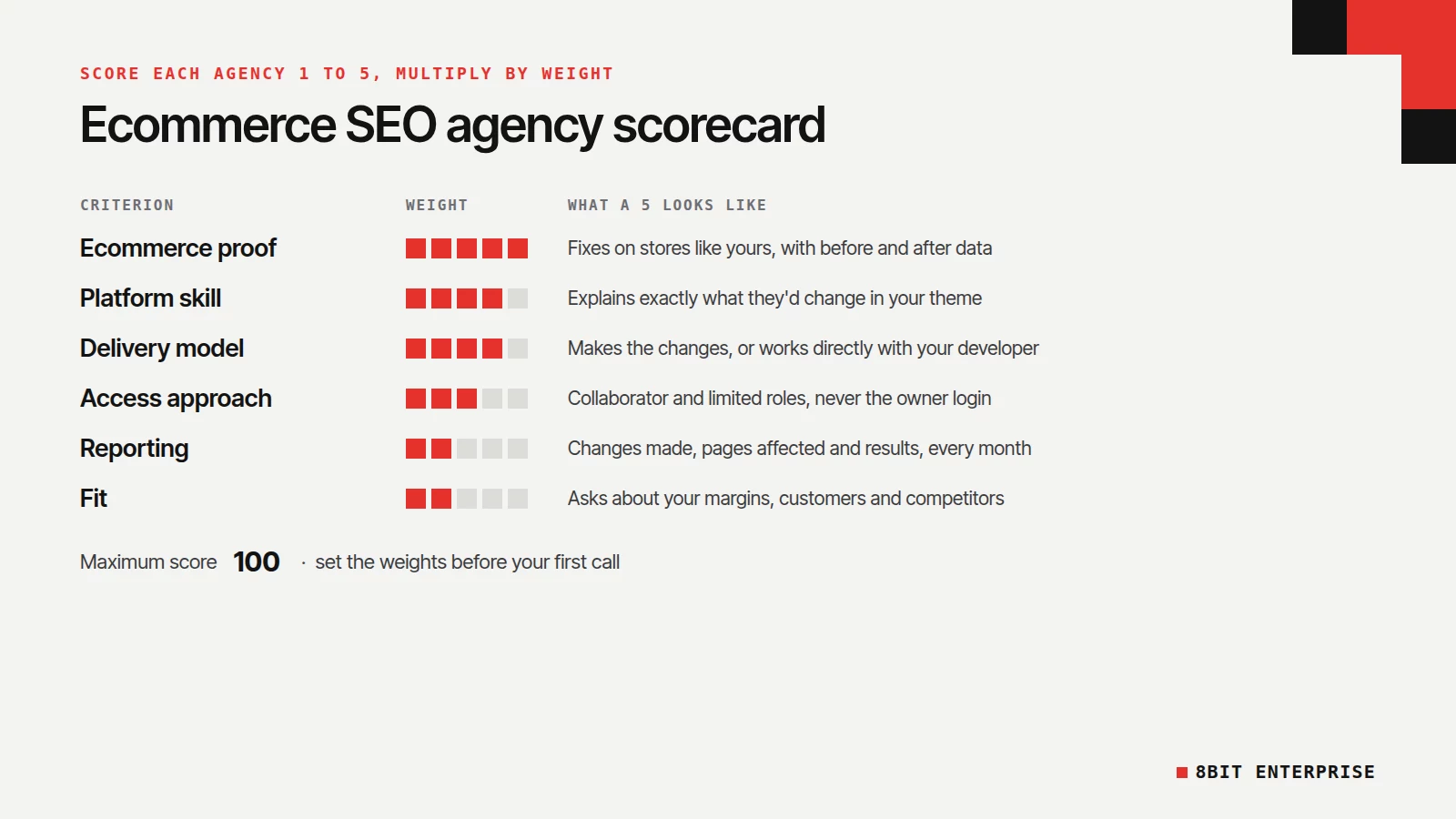
The scorecard below is the core of how to choose an ecommerce SEO agency: it turns six calls into one comparable number. Score each agency from 1 to 5 on every row, multiply by the weight and add the results. With these default weights, the maximum is 100.
Adjust the weights to your store before the first call, not after, so a charming pitch can’t move the goalposts. If your weights add up to more or less than 20, compare agencies as a percentage of your maximum score.
| Criterion | Weight | What a 5 looks like | How to check it |
|---|---|---|---|
| Ecommerce proof | 5 | Shows fixes on stores like yours, with before and after data | Ask for two examples and a reference you can call |
| Platform skill | 4 | Explains exactly what they’d change in your theme or plugins | Ask how they’d fix one real issue on your store |
| Delivery model | 4 | Makes the changes, or works directly with your developer | Ask who writes the code and how long fixes take |
| Access approach | 3 | Asks for collaborator and limited roles, never the owner login | Ask what access they need in month one |
| Reporting | 2 | Monthly report lists changes made, pages affected and results | Ask for a sample report with client names removed |
| Fit and communication | 2 | Asks about your margins, customers and competitors | Note how many questions they ask you |
A top score on ecommerce proof, 5 multiplied by its weight of 5, gives 25 points, the biggest single block. That’s deliberate. An agency that has solved your exact problem before saves you months of paying for them to learn.
Write your scores straight after each call with an ecommerce SEO agency. Memory fades fast, and the last agency you spoke to always seems best on day three.
How Do the Criteria Change for Different Stores?
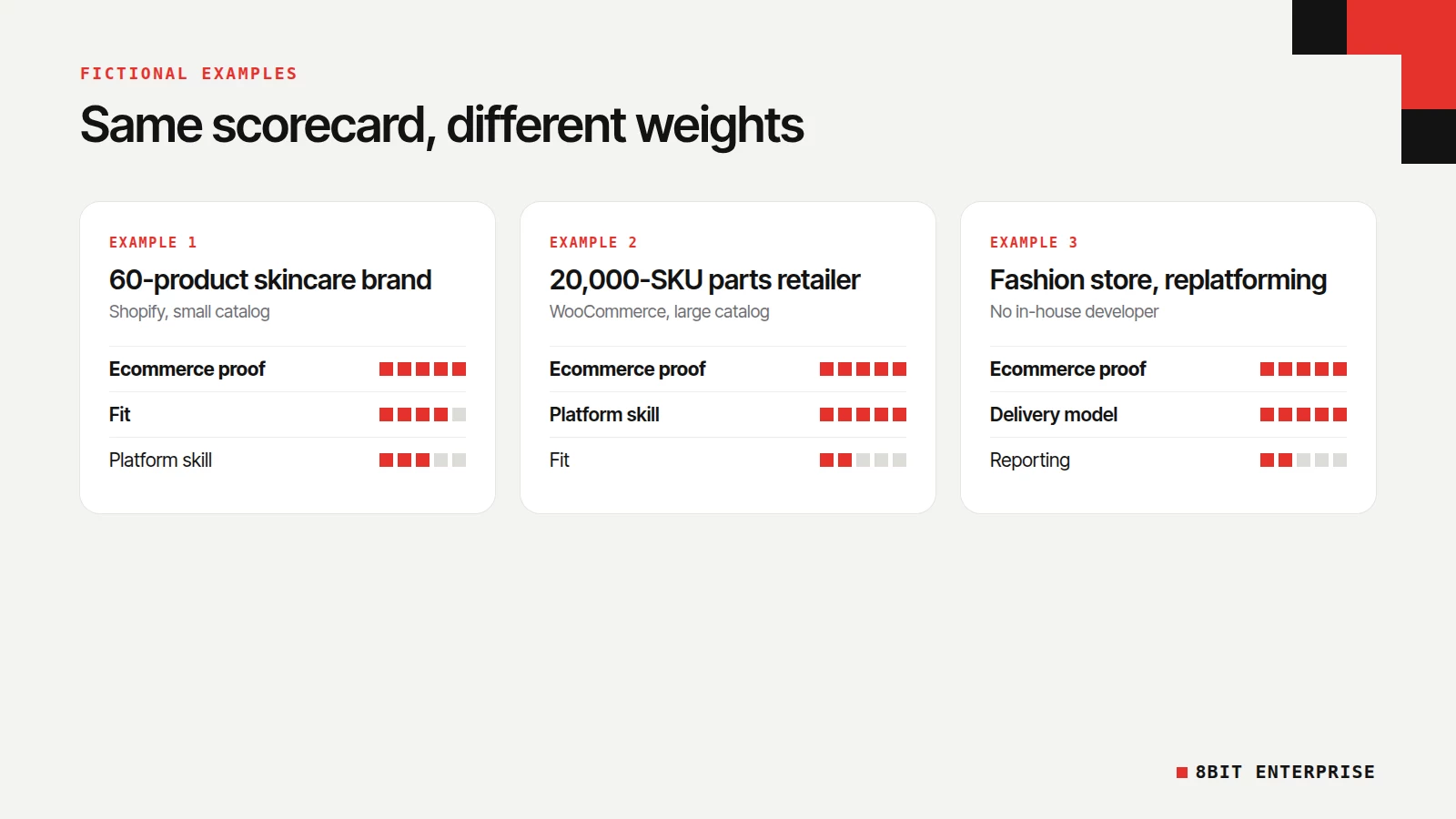
The criteria for an ecommerce SEO agency stay the same, but the weights shift with your catalog size and in-house team. A store with its own developer cares less about delivery, while a store with nobody technical cares a lot. The three example stores below are fictional, but they show how to set weights before your first call.
Example 1: A 60-product skincare brand on Shopify
A small catalog has few technical problems, so the big wins are product page content, collections and links. This store should raise the weight on fit and communication to 4, and drop platform skill to 3. Shopify already generates a sitemap automatically, so a content-strong agency will usually beat a technical specialist here.
Example 2: A 20,000-SKU parts retailer on WooCommerce
Large catalogs live or die on crawling and indexing. This retailer should keep ecommerce proof at 5 and raise platform skill to 5, because faceted navigation, duplicate products and slow category pages will be the main issues. Any agency that can’t explain how they’d handle parameter URLs gets a 1 on that row. For a store like this, how to choose the right technical SEO agency matters more than content skills.
Example 3: A fashion store with no developer, planning a replatform
No developer means delivery model becomes the top priority, so raise it to 5. A replatform also brings URL changes, and Google’s guide to site moves with URL changes warns that rankings can fluctuate during a move, and that for medium-sized sites it can take a few weeks or more for Google to start showing the new URLs. This store needs an agency that has run migrations before, with a redirect plan in writing.
How to Choose an SEO Agency in 6 Steps
Choosing an ecommerce SEO agency takes about two weeks if you run it as a short project. Define needs, shortlist three to five agencies, run the same call with each, score them, check references, and only then compare prices. The order matters, because price discussions too early anchor you on the cheapest option.
- Write a one-page brief. List your platform, catalog size, monthly revenue from search if you know it, your three biggest search problems, and who on your team can approve changes.
- Set your weights. Copy the scorecard above and adjust the weights to your store, using the three examples as a guide.
- Shortlist three to five agencies. Look for published ecommerce work, reviews on directories such as Clutch, and content that shows they understand online stores.
- Run the same call with each. Send your brief in advance, then ask the same questions in the same order, including the ones from Google’s guide.
- Score straight after each call. Fill in the scorecard within the hour and note anything you need to verify.
- Check references, then compare quotes. Call one past client per finalist, and only then put the proposals side by side on price and scope.
If you’re comparing an SEO agency against a freelancer at step 3, the same scorecard works. Freelancers often score high on fit and lower on delivery capacity, so the weights make the tradeoff visible.
What Questions Should You Ask Before Choosing an SEO Agency?
Ask any ecommerce SEO agency questions that force specific answers about your store. Good ones cover a real problem on your site, who writes the code, what access they need, what the monthly report includes, and how they’ll measure success. Google’s own hiring guide adds two more: what results they expect, and in what timeframe.
These are the questions we’d put on every call:
- What’s the first problem you’d fix on our store, and why that one?
- Who makes the changes: you, our developer, or both?
- What access do you need in the first month, and at what permission level?
- Can we see a sample monthly report?
- How will you measure success, and when should we expect to see it?
Listen for the first answer more than the others. An agency that has looked at your store before the call will name something real, like thin collection pages or indexed filter URLs.
Common Mistakes When Choosing an SEO Agency
The most common mistake when choosing the right SEO agency is comparing prices before comparing scope. Two quotes at $1,500 a month can cover completely different work: one includes making the changes, the other sends a list. Other frequent mistakes are skipping reference calls, handing over owner logins, and choosing on a sales call instead of on proof.
Price comparisons are especially misleading in SEO. The Ahrefs survey of 439 SEO providers found an average retainer of $2,917 a month, while the most common range was just $501 to $1,000. A wide spread like that means the same budget can buy very different things.
Another mistake is judging too early. Google’s SEO Starter Guide says some changes take effect in a few hours while others can take several months, and suggests waiting a few weeks before deciding whether a change helped. Agree review points by quarter in the contract.
This guide doesn’t cover warning signs in depth. For the outright red flags, such as ranking guarantees, see the red flags section of our in-house vs outsourced SEO comparison, linked at the top of this guide.
How 8Bit Enterprise Handles This
We’d rather you score us than take our word for it, so here’s how our ecommerce SEO services map to the scorecard. Month one is a technical and content audit with a prioritized fix list, plus Google Search Console tracking.
Each month after that, the report shows which keywords moved, how traffic changed and how many leads came from search.
On delivery, our web development team can fix slow or unclear pages directly rather than sending you a list of recommendations. That matters most for stores like Example 3, with no developer in-house.
Use the same questions on us that you’d use on anyone else. If we’re not the right fit for your store, the scorecard will show it.
Frequently Asked Questions
How much does an SEO agency cost for an ecommerce store?
Ahrefs surveyed 439 SEO providers and found an average retainer of $2,917 a month, with $501 to $1,000 the most common range. Large catalogs usually need more technical work, so ask how each quote scales with your product count. Compare scope before price, since a cheaper quote may exclude making the changes. Our breakdown of SEO packages for small business shows what different budgets buy.
What access should I give an SEO agency?
Give the least access that lets them do the job, and keep ownership yourself. A sensible starting point:
- Search Console: read access during the audit, full user later if needed.
- Shopify: a collaborator account with limited permissions.
- Google Analytics: a Viewer role to start.
- Never share the store owner login.
When should you choose an SEO agency over a freelancer?
An agency suits stores that need several skills at once, such as technical fixes, content and links. A freelancer suits a focused job, like a one-off audit or ongoing product page copy. Score both on the same scorecard, since freelancers often win on fit and lose on capacity.
How long does it take an SEO agency to show results?
Google’s SEO Starter Guide says some changes take effect in a few hours, while others can take several months. Expect technical fixes to show first, then content and links over the following quarters. Agree review points every three months rather than judging after a few weeks.
What’s the best SEO agency for e-commerce?
There’s no single best SEO agency for e-commerce, because the right fit depends on your platform, catalog size and in-house team. The best choice is the agency that scores highest on your own weighted scorecard and can show fixes on stores like yours, backed by a reference you can call.
Is it better to choose an SEO agency in the UK for a UK store?
Location matters less than market knowledge. When you choose an SEO agency for the UK market, check they understand UK spelling, currency, delivery terms and local competitors in your category. Google’s hiring guide suggests asking about experience in your country, so add it to your scorecard as part of ecommerce proof.
Conclusion
Knowing how to choose an ecommerce SEO agency comes down to doing the scoring before the selling starts. Write a short brief, set your weights, ask every agency the same questions, and score straight after each call. Then check references and compare quotes on scope, not just price. If you’d like a second opinion on your shortlist or want to put us through the same test, book a free discovery call with 8Bit Enterprise.