
Quick answer: Agentic commerce vs traditional e-commerce comes down to who does the shopping. In traditional e-commerce, the shopper searches, compares and checks out. In agentic commerce, an AI agent does some of that work. As of November 2026, most AI shopping still ends on the store’s own checkout, so product data matters more than new payment tech.
What Is Agentic Commerce?
Agentic commerce is online shopping where an AI agent searches, compares and sometimes buys on a person’s behalf. The comparison of agentic commerce vs traditional e-commerce matters to small stores because the agent, not the shopper, reads your product data first. If that data is thin or wrong, you may never be recommended.
That’s the simple agentic commerce definition. The harder question is what it means for a store with a few hundred products this month.
We read the pages ranking highest for this comparison in November 2026. They define the idea well. None of the four we could open gives the current status and dates of these programs, what they cost merchants, how a Shopify or WooCommerce store joins, or how to measure the sales. This guide covers those, using each company’s own documentation.
TL;DR
- OpenAI says ChatGPT is moving away from standalone Instant Checkout, and purchases finish on merchant sites or apps.
- Shopify’s Agentic Storefronts are on by default for eligible stores, covering ChatGPT, Google AI Mode, Gemini, Copilot and Meta.
- Google’s Universal Commerce Protocol was announced in January 2026 for eligible US retailers.
- Adobe found AI traffic to US retail sites converted 90% better than other traffic in September 2026.
How Is Agentic Commerce Different From Traditional E-commerce?
Agentic commerce differs from traditional e-commerce mainly in discovery. A shopper asks an AI assistant for a recommendation instead of searching and browsing store by store. The assistant compares products from structured data, then sends the shopper to buy. In a few programs, the agent can also complete checkout inside the AI app itself.
| Shopping step | Traditional e-commerce | Agentic commerce today |
|---|---|---|
| Finding products | Search engine, ads, browsing | Asking an AI assistant |
| Comparing | Shopper opens several tabs | Agent compares from product data |
| What the store controls | Pages, design, copy | Product feed, data accuracy, reviews |
| Checkout | On the store’s website | Mostly on the store’s website, sometimes inside the AI app |
| Tracking the visit | Search and ad reports | Referral tags, often incomplete |
So how is agentic commerce different from traditional e-commerce for you? Your product feed starts doing the job your homepage used to do. That’s the practical core of agentic commerce vs traditional e-commerce for a small store.
What Makes Agentic Storefronts Different From Traditional Stores?
An agentic storefront lets AI assistants show, compare and sometimes sell your products before a shopper ever visits your website. A traditional storefront waits for visitors to arrive on your site. Shopify uses the name Agentic Storefronts for its version, which sends your catalog to AI channels and is on by default for eligible stores.
The practical differences:
- Where shoppers meet you: inside an answer in ChatGPT, Google AI Mode, Gemini, Copilot or Meta, instead of on your homepage.
- What does the selling: your product data, such as titles, prices, stock and reviews, rather than page design and copy.
- Where checkout happens: ChatGPT sends shoppers to your store. Shopify says Google, Copilot and Meta can use direct checkout once you activate it.
- What you control: your feed and how accurate it is. You can’t design how an AI answer looks.
Your own website still matters, because ChatGPT purchases finish there. Think of an agentic storefront as a second shop window that only reads your data.
Which Ecommerce Platforms Support Agentic Commerce?
As of November 2026, Shopify has the most built-in support: its Agentic Storefronts connect eligible stores to ChatGPT, Google AI Mode and Gemini, Microsoft Copilot and Meta. Other platforms, including WooCommerce, mostly take part through product feeds sent to ChatGPT and to Google Merchant Center, rather than a built-in switch.
| Platform | How it connects to AI shopping | Built in? |
|---|---|---|
| Shopify | Agentic Storefronts, on by default for eligible stores. ChatGPT says Shopify catalogs need no extra setup | Yes |
| WooCommerce | Product feeds to ChatGPT (SFTP, APIs or a feed provider) and to Google Merchant Center | No built-in option we could confirm |
| Other platforms | Product feeds, plus Google’s Universal Commerce Protocol for eligible US retailers | Check with your platform |
We haven’t verified every vendor’s roadmap, so ask yours two questions: can it send a product feed to ChatGPT, and does it support Google Merchant Center? If both answers are yes, your store has the basics in place.
What’s Actually Live for Small Stores in November 2026?
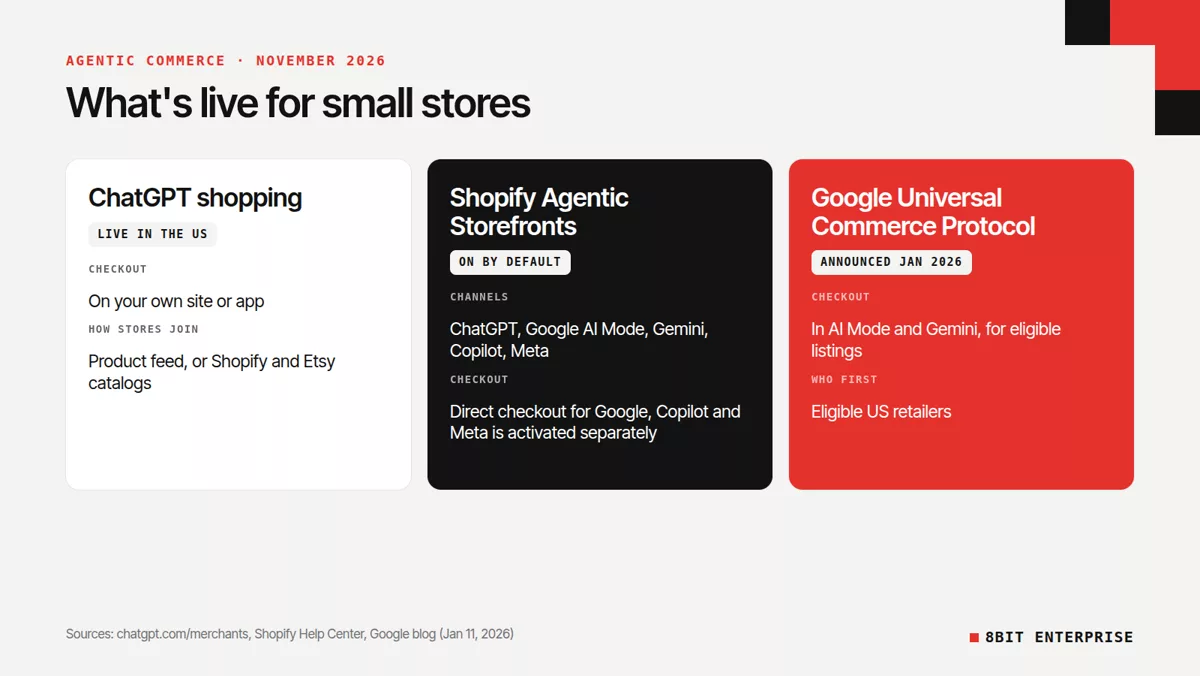
As of November 2026, three programs matter most to small stores: ChatGPT shopping, Shopify Agentic Storefronts and Google’s Universal Commerce Protocol. Only some offer checkout inside the AI app. The status of each changed during 2026, so check the date on anything you read about agentic checkout before acting on it.
| Program | What it does | Checkout | Who can use it |
|---|---|---|---|
| ChatGPT shopping | Shows products in ChatGPT answers | On the merchant’s own site or app | Live in the US; most merchants start with a product feed |
| Shopify Agentic Storefronts | Sends your catalog to AI channels | ChatGPT sends shoppers to your store; Google, Copilot and Meta can use direct checkout once activated | On by default for eligible Shopify stores |
| Google Universal Commerce Protocol | Open standard for agent checkout | Announced for AI Mode and Gemini | Eligible US retailers, with expansion planned |
ChatGPT changed course in 2026. Its merchant page says OpenAI is moving away from a standalone Instant Checkout experience and that purchases are completed on merchant-owned websites or apps. The same page says there are no fees on purchases that start in ChatGPT.
Shopify’s Agentic Storefronts help page lists ChatGPT, Google AI Mode and Gemini, Microsoft Copilot and Meta surfaces. It says the feature is active by default for eligible stores.
Google announced the Universal Commerce Protocol on January 11, 2026. It said the protocol would soon power checkout on eligible product listings in AI Mode and the Gemini app, and that retailers remain the seller of record. We couldn’t confirm from Google’s own pages how widely that checkout has rolled out since, so check Merchant Center for your account’s eligibility.
How Does Agentic Commerce Work for Shopify and WooCommerce Stores?
How does agentic commerce work for a small store? Mostly through product data that AI platforms read. Shopify stores are connected through Agentic Storefronts, and ChatGPT says Shopify catalogs are already integrated with no extra setup. WooCommerce stores have no built-in equivalent we could confirm, so they rely on product feeds and Google Merchant Center.
Shopify stores
Check the setting rather than assuming. In your Shopify admin, go to Sales channels, then Agentic, and choose which AI channels to sell on. Shopify says direct checkout for Google, Microsoft Copilot and Meta must be activated separately.
WooCommerce stores
A WooCommerce store needs a product feed for each channel. ChatGPT’s merchant page says most merchants start with product feeds, sent by SFTP, APIs or a supported feed provider. Google’s shopping surfaces use your Merchant Center product data.
If you’re still choosing a platform, this difference belongs in your decision. Our Shopify vs WooCommerce comparison covers the other trade-offs.
Tips for Preparing Your Online Store for ChatGPT Shopping
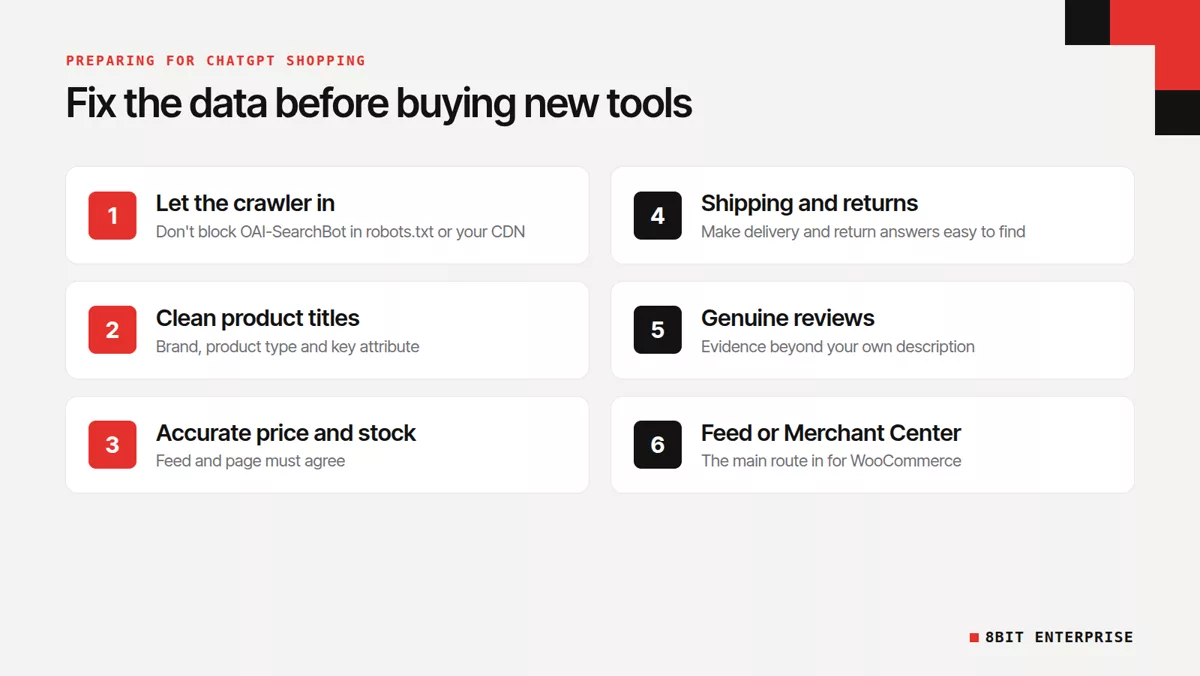
The best tips for preparing your online store for ChatGPT shopping are about data, not new software. AI agents compare what they can read: titles, prices, stock, shipping and reviews. Fix those first, because every program above depends on them, and most of the work also helps Google Shopping.
- Let the crawler in. OpenAI’s publisher FAQ says content can appear in ChatGPT answers only if OAI-SearchBot isn’t blocked. Check robots.txt and any CDN or firewall bot rules.
- Clean your product titles. Use the brand, product type and key attribute, such as size or material.
- Keep price and stock accurate. Google Merchant Center disapproves products when the availability in your feed and on your page disagree.
- Publish shipping and return details. Shoppers ask assistants about delivery and returns, so make those answers easy to find.
- Collect genuine reviews. They give shoppers and assistants evidence beyond your own description.
- Set up a feed or Merchant Center. This is the main route in for WooCommerce stores.
Our guide to GEO for ecommerce covers how AI tools choose which stores to cite.
How Do You Measure Sales From AI Shopping Agents?
Measure AI shopping traffic through referral data in Google Analytics 4. OpenAI’s Publishers and Developers FAQ says ChatGPT adds utm_source=chatgpt.com to referral links. Build a custom channel group for AI sources, then compare their orders and revenue with your other channels.
Expect gaps. Shoppers who copy a link from an AI answer arrive with no referral data, so some AI-driven orders will show as direct traffic. Treat your AI numbers as a minimum when you weigh agentic commerce vs traditional e-commerce channels.
The traffic is worth tracking. Adobe’s 2026 holiday retail data found AI traffic to US retail sites converted 90% better than non-AI traffic in September 2026, with 83% higher revenue per visit. Adobe measured the quality of that traffic, not how much of it there was.
Should a Small Store Prioritize Agentic Commerce Yet?
Most small stores should prepare their data now and wait on anything that costs money. ChatGPT shopping is live only in the US, Google’s agent checkout was announced for eligible US retailers, and OpenAI itself stepped back from in-chat checkout. Data work pays off in search either way, so it isn’t wasted.
Our advice is to hold off on paid agentic commerce platforms if you sell mainly outside the US, sell custom or made-to-order products, or rely on phone or in-person sales. Spend that budget on feed quality and product pages first.
A store selling standard products to US shoppers through Shopify is in the best position. Much of the connection is already switched on.
Common Mistakes With Agentic Commerce
The most common mistake is assuming the AI platforms can see your store. Bot rules on a CDN or firewall can block AI crawlers without anyone noticing, and a blocked crawler means no recommendations. Other mistakes include buying an agentic AI ecommerce tool before fixing product data, and trusting old articles about features that have since changed.
Read program pages, not summaries. Articles from late 2025 describe Instant Checkout as live inside ChatGPT, but OpenAI’s merchant page now says it’s moving away from that model.
Don’t overlook your existing channels either. In the debate over agentic commerce vs traditional e-commerce, your store’s own search, ads and email traffic is still the part you can measure best.
Frequently Asked Questions
What does agentic commerce mean?
Agentic commerce means AI agents carry out shopping tasks for a person, such as finding, comparing and sometimes buying products. The agentic commerce meaning is broader than a chatbot, because the agent acts on the shopper’s request. In November 2026, most of these purchases still finish on the store’s own website.
Does ChatGPT charge merchants for sales?
OpenAI’s merchant page says there are no fees on purchases that start in ChatGPT. The page also says ChatGPT is moving away from standalone Instant Checkout, so purchases are completed on the merchant’s own website or app. That means your usual payment processing fees still apply at checkout.
Is Google AI shopping the same as agentic commerce?
Google AI shopping is one form of agentic commerce. Google’s Universal Commerce Protocol, announced on January 11, 2026, is designed to let agents check out on eligible product listings in AI Mode and the Gemini app. Google said eligible US retailers come first, with expansion planned.
What do I need to sell through AI shopping agents?
A store needs accurate, readable product data before anything else:
- A product feed or a Shopify store with Agentic Storefronts active
- Crawlers such as OAI-SearchBot allowed in robots.txt
- Correct prices, stock and shipping details
- Clear return policies and genuine reviews
Will agentic commerce replace traditional e-commerce?
Agentic commerce currently adds a new discovery channel rather than replacing online stores. OpenAI’s merchant page says ChatGPT purchases are completed on merchant-owned websites or apps, so the store and its checkout remain central. Stores that keep clean product data can serve both shoppers and agents.
Conclusion
Agentic commerce vs traditional e-commerce isn’t a choice you have to make yet. Keep your store, and make your product data easy for AI agents to read. If you’d like help preparing your catalog and feeds, our ecommerce team can audit and fix them.